Guides
Can You Reuse YouTube Thumbnails? Copyright Boundaries for Creators
Quick takeaways
Quick summary
Use a practical copyright-risk checklist for YouTube thumbnail research, reference boards, fair-use questions, and original thumbnail rebuilds.
If you work on thumbnails long enough, you eventually save examples from other channels. A strong composition. A smart text treatment. A color balance that works. Then the uncomfortable question shows up: where does inspiration end and copying begin?
This guide is not legal advice. Copyright questions depend on jurisdiction, facts, purpose, and the exact material being reused. Treat this page as a creator workflow checklist: it helps you keep research, reference boards, and final thumbnail production separated so a useful example does not turn into a near-copy.
Quick answer
Opening a public YouTube thumbnail for research is different from reusing it as your own creative asset. Use thumbnails as reference material: study layout, contrast, framing, topic promise, and feed readability, then rebuild the final thumbnail with your own images, typography, copy, and composition.
Use the YouTube Thumbnail Downloader for reference research, then compare your own draft in Compare My Thumbnail. If the final image still depends on someone else's exact execution, slow down before publishing.
The practical boundary: research is not the same as republication
A safe reference workflow has two separate phases:
- collect examples to understand patterns
- create a new thumbnail from your own assets and decisions
Problems usually start when those phases blur together. If the reference image becomes the base layer, the same crop is traced, or the same emotional setup is copied without meaningful change, the final thumbnail can become hard to defend as original work.
Why thumbnails can raise copyright questions
YouTube's copyright guidance explains that original creative work is generally protected when it is creative and fixed. It also notes that ideas, facts, and processes are not protected in the same way as expression. For thumbnails, that distinction matters.
You can learn from an idea such as "before/after contrast" or "face plus one large number." You should be more careful with exact expression: a specific photo, illustration, edit, layout arrangement, graphic treatment, or near-identical visual scene.
A reference-board workflow that keeps distance
When you save examples, write down the pattern in words before you open your design tool. That small step forces you to translate the reference into an idea instead of copying the pixels.
Use this note format:
- Source pattern: what works in the reference?
- Viewer job: what does the viewer understand in two seconds?
- Rebuild rule: what must be new in my version?
- Risk note: what would make this look too close?
Example:
- Source pattern: tense split-screen contrast
- Viewer job: understand a surprising before/after result
- Rebuild rule: use my own face, my own screenshots, different color roles, and a different text angle
- Risk note: do not keep the same red arrow, same crop, same facial pose, and same left/right arrangement together
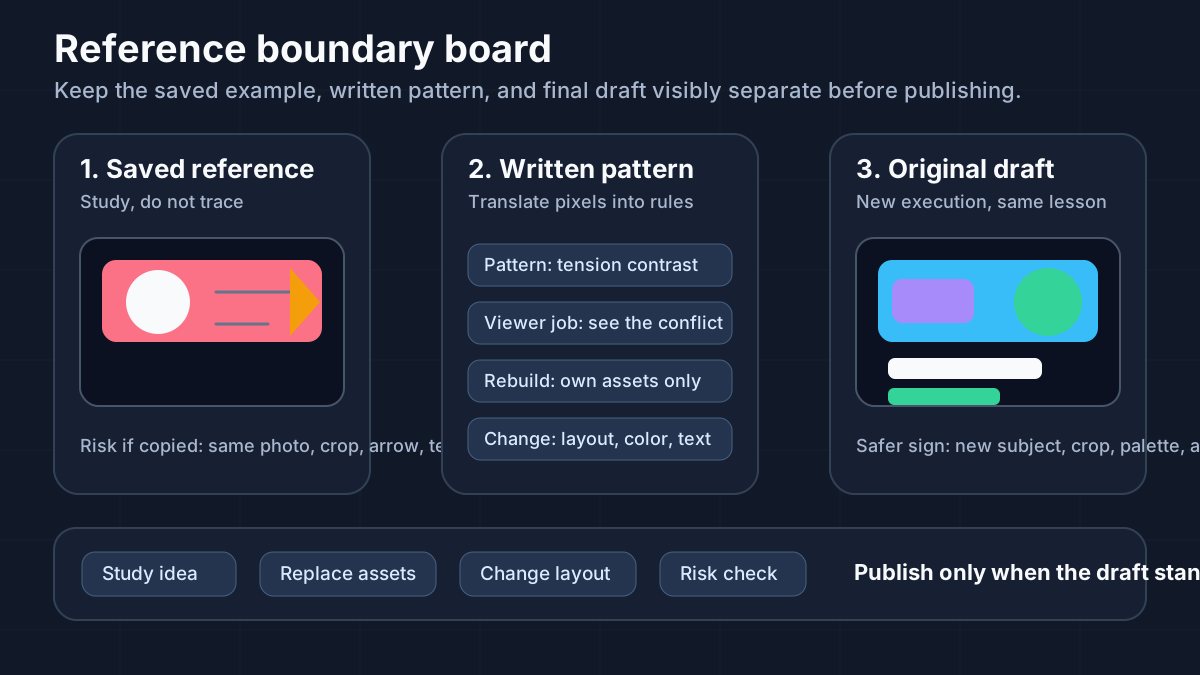
Idea versus expression in thumbnail work
Use this as a practical design test:
| You can usually study | You should avoid copying directly |
|---|---|
| A broad contrast pattern | The same photo or illustration |
| A color role such as warning red | The same palette, crop, and effects together |
| A headline structure | The same wording and text placement |
| A layout principle | A near-identical arrangement of all major elements |
| A category convention | A recognizable creator's exact visual style |
No table can answer every legal edge case. The point is to keep your final thumbnail visibly based on your own material and choices.
Fair use is not a magic label
Creators often assume that review, commentary, research, or education automatically makes reuse safe. YouTube's fair-use guidance is more careful than that. It says fair use is judged case by case, rules differ by country or region, and courts ultimately decide.
In the United States, fair use analysis commonly looks at purpose and character, the nature of the work, the amount used, and market effect. A thumbnail that merely copies another thumbnail's core visual appeal is much harder to reason about than a thumbnail that uses a small reference inside clear commentary or criticism.
So do not rely on labels like "no infringement intended," "educational," or "inspired by." Use those words only if the actual design process supports them.
Lower-risk routes when you need outside material
If your thumbnail needs material you did not create, slow down and choose a clearer rights path:
- use your own photos, screenshots, drawings, and graphic assets
- get permission from the rightsholder
- use material under the license terms that actually allow your intended use
- verify that public-domain claims are real before relying on them
- use only the amount needed for commentary, criticism, or explanation when a copyright exception may apply
YouTube's copyright guidance also warns that permission, exceptions, Creative Commons, or public-domain routes do not guarantee that you will avoid every claim, dispute, or strike. That is why a thumbnail built mostly from your own assets is usually the cleaner production habit.
What can happen if the owner objects
YouTube says a copyright removal request is a legal request from a copyright owner or authorized representative. If a request appears valid, YouTube removes the content and applies a copyright strike. YouTube also describes response paths such as waiting for a strike to expire after Copyright School, getting a retraction, or submitting a counter notification when the uploader believes the removal was a mistake or qualifies for an exception.
This does not mean every thumbnail dispute becomes a strike. It does mean a casual "I thought it was fine" is a weak production plan.
Pre-publish copyright-risk checklist
Before the thumbnail goes live, answer these questions:
- Did we use the reference only to identify a pattern, or did we build on top of the original image?
- Are all major assets in the final thumbnail ours, licensed, public domain, or otherwise clearly usable?
- Did we change the subject, crop, text, layout rhythm, and color roles enough that the work stands on its own?
- If the original creator saw the final thumbnail, would they recognize a general idea or too much exact execution?
- Could we explain the design process without hiding a copied layer, traced layout, or borrowed graphic?
- Is this a rights question that should go to legal advice instead of a publishing shortcut?
If any answer feels weak, rebuild the thumbnail from a more general idea.
Example: learning without copying
Suppose you admire a finance channel thumbnail with a shocked face, a red arrow, and a split-screen comparison. You can learn from the idea of contrast and tension without copying the original expression.
A safer rebuild might use:
- your own host photo or original illustration
- a different split structure or no split at all
- a different color role for risk or urgency
- a new text promise written for your video
- a different focal object and visual hierarchy
The result can still use the same broad lesson: make the viewer understand the conflict quickly. It should not look like a disguised version of the original.
Red flags that the design is too close
Slow down when you see these signs:
- the same source image or illustration remains in the draft
- the crop, face angle, color, text location, and emotional framing all match the reference
- the thumbnail only feels strong because the original reference did the creative work
- you would be uncomfortable showing the source reference beside your draft
- the final design is hard to describe without naming the reference creator
These are practical warning signs, not legal tests. But they catch many risky workflows before publication.
Related official sources
For the policy side, start with YouTube's own copyright resources:
- Copyright on YouTube
- Fair use on YouTube
- About copyright removal requests
- Submit a copyright counter notification
FAQ
Is downloading a public YouTube thumbnail illegal by itself?
In many workflows, opening or saving a thumbnail for research is different from republishing it as your own creative asset. The higher-risk action is reuse, not inspection.
Does giving credit make thumbnail reuse safe?
No. Credit can be useful context, but it does not automatically create permission or fair use. The actual use still matters.
Does adding commentary automatically make thumbnail reuse fair use?
Not automatically. Commentary can matter, but fair use and similar exceptions are fact-specific and differ by jurisdiction.
What is the lowest-risk way to learn from another thumbnail?
Write down the pattern you want to learn, then rebuild the final design with your own assets, layout, text treatment, and channel-specific promise.
What should I do if my thumbnail still feels too close to a reference?
Change the source assets first, then change the framing, text structure, and main contrast point. If it still depends on the original to work, start again from a broader idea.
Related guides
Published
2026-03-05
Estimated reading time
7 min
Word count
1,519
Editorial notes
How this guide was prepared
This guide is edited for practical use, clear claims, copyright boundaries, and a direct next step into the relevant tool or policy page.
Written by
GrabThumbs Editorial Team
Reviewed by
GrabThumbs Editorial Team
Review focus
Practical usefulness, clarity of claims, safer reuse boundaries, and stronger links to the next relevant tool or policy page.
Update practice
2026-03-05
The guide is revisited when workflow advice, platform behavior, or policy context changes in a meaningful way.
Corrections or policy questions
Use the contact page if you spot an accuracy, copyright, or policy issue that should be reviewed.
Open contact pageTry the tool
Test this with a real YouTube thumbnail
Paste a public YouTube URL to open available thumbnail sizes, compare readability, copy the direct image URL, or download the image without login.
Open YouTube Thumbnail DownloaderTool loading
The inline thumbnail extractor will load as you approach it
The article loads first, then the public YouTube thumbnail test tool hydrates near this section.
Guide support
How this guide is maintained
This article is part of the GrabThumbs editorial library and links to the site standards, product context, and contact path so readers can verify how the site is run.
Thumbnail Extractor
Open live public YouTube thumbnails right after reading so you can compare the guidance against real examples.
Standards
Review the editorial, corrections, and advertising standards that apply across the site.
About GrabThumbs
See what the site publishes, how the utility works, and how the editorial library fits into the product.
Contact
Use the contact page for policy, copyright, accuracy, or business questions.
Reading path
Continue with the same goal
These guides belong to the same goal-based path as the article you are reading, so you can keep moving through the topic without jumping around the archive.
These guides help you separate reference research from risky reuse before you copy what another channel is doing.
Thumbnail planning in the AI era: using Google AI without losing the human eye
Generative AI can speed up thumbnail planning, but it still works best as a thinking partner, not a replacement.
Read this guide →
5 times downloading a YouTube thumbnail actually matters
From competitor research to archiving, these are the moments when having the original thumbnail file genuinely helps.
Read this guide →
Related guides
Keep reading within the same topic cluster with these related articles.
YouTube CTR Diagnosis: When to Change Your Thumbnail vs Keep It
Use traffic-source context, 48-hour checks, and thumbnail-title promise matching before changing a thumbnail because CTR dropped.
Read this guide →
3 fundamentals that make YouTube thumbnails easier to click
A lot of thumbnail improvement comes from boring basics done well: contrast, compression, and a clear emotional cue.
Read this guide →
YouTube Thumbnail A/B Testing: A Clean 2026 Workflow
Run a cleaner YouTube thumbnail A/B test: use the current Studio feature when eligible, separate concurrent tests from manual monitoring, and record one clear hypothesis.
Read this guide →
Time to put theory into practice!
Open competitor thumbnails right away for comparison and analysis.
Go to Thumbnail Extractor